What Every SWIFT-Connected Entities Needs to Know; and How to Get and stay Compliant
Introduction
Every financial institution, corporate, or market infrastructure connected to the SWIFT network carries a shared responsibility: keeping its own corner of the network secure. The SWIFT Customer Security Programme (CSP) exists to make that responsibility concrete, measurable, and auditable. For SWIFT users, compliance is not optional. It is a condition of remaining connected to the network in good standing.
This brief explains what the CSP is, why it matters, what CSCF v2026 changes for your organization, and how Timestell Consulting helps entities move from uncertainty to a confident, evidenced attestation in readiness for the SWIFT Customer Security Programme (CSP) Assessment 2026.
1. What Is the SWIFT Customer Security Programme?
SWIFT introduced the CSP in 2016, following a wave of high-profile cyber-enabled fraud incidents in which attackers compromised a bank’s local environment; not SWIFT’s core network to send fraudulent payment instructions. The lesson was clear: the security of the overall network depends on the security of every connected participant, not just SWIFT itself.
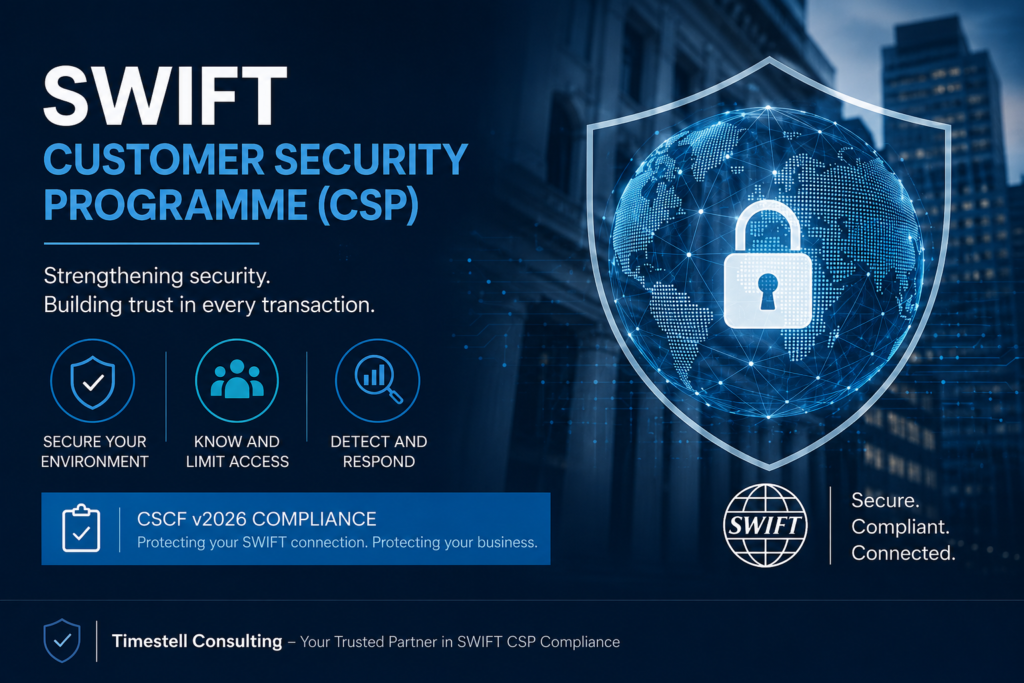
The CSP’s technical backbone is the Customer Security Controls Framework (CSCF): a structured set of security controls that every SWIFT user must implement, self-assess against, and have independently verified on an annual basis. The CSCF draws on established standards such as NIST, ISO 27001, and PCI DSS, and organizes its requirements around three core objectives:
-
- Secure your environment — Protect the local SWIFT infrastructure and restrict it from the wider corporate network.
-
- Know and limit access — Enforce least-privilege access, strong authentication, and personnel vetting.
-
- Detect and respond — Monitor for anomalies and maintain an incident response capability.
Which controls apply, and at what level of rigour, depends on an institution’s declared architecture type (A1 through E, reflecting how the entity connects to SWIFT directly, via a service bureau, via a group hub, and so on).
2. Why Compliance Is Mandatory, Not Optional
Every institution holding a SWIFT Business Identifier Code (BIC) is required to comply with the CSP. Compliance is enforced through the annual Know Your Customer Security Attestation (KYC-SA): each user attests to its level of compliance with mandatory controls, and that attestation is visible to counterparties through the KYC-SA application.
This visibility has real commercial consequences. Correspondent banks and counterparties increasingly review a partner’s CSP attestation before continuing or expanding a relationship. A weak or overdue attestation can trigger enhanced due diligence, transaction restrictions, or in persistent non-compliance cases reporting to local regulators and supervisors. For many entities, CSP compliance has effectively become a precondition for maintaining correspondent banking relationships.
3. What’s New in CSCF v2026
SWIFT updates the CSCF annually to keep pace with the evolving threat landscape. The 2026 edition (effective from its publication in mid-2025, with attestation due by year-end) maintains the same three-objective, seven-principle structure as prior years but introduces one significant change and several clarifications:
| Key CSCF v2026 changes at a glance • 32 total controls, with 26 now mandatory and 6 advisories — One control moved from advisory to mandatory this cycle. • Control 2.4 (Back Office Data Flow Security) is now mandatory, extending required protection to the data flows between the SWIFT secure zone and back-office systems. • Expanded recognition of ‘customer connectors’ API consumers, middleware, and file-transfer clients bringing more indirect connection methods explicitly into scope. • Continued clarification of requirements for cloud-hosted and virtualized connectivity (e.g., virtual VPN deployments), as SWIFT’s Alliance Connect infrastructure transitions toward SD-WAN. |
The practical impact: An institution that was fully compliant under the prior version can find itself with a new gap in this cycle purely because the framework moved; not because its own environment changed. Confirming your architecture type and control applicability early is the single most effective way to avoid last-minute surprises.
4. The Compliance Journey: What’s Actually Required
4.1 Self-assessment and independent assessment
Entities self-assess against the applicable controls and then submit to an independent assessment performed either by an internal audit function operating independently of the teams being assessed, or by an external qualified assessor. The assessment must verify, with evidence, that mandatory controls are properly implemented, not merely documented as policy.
4.2 Attestation via KYC-SA
Results are submitted through the KYC-SA application and become visible to counterparties who query your institution’s security posture. Attestation is required annually, and any material change to your architecture type, or environment should trigger a re-assessment.
4.3 Common gaps we see in practice
-
- Evidence gaps: Controls are technically implemented but lack the documentation and assessors need to verify them the most frequent cause of assessment findings.
-
- Scope misclassification: Incorrect architecture type selection, leading to under or over-application of controls.
-
- Third-party and connector blind spots: Service bureaus, middleware, and outsourced infrastructure not clearly mapped into the assessment scope.
-
- Access management drift: Privileged access reviews and segregation of duties not consistently maintained between assessment cycles.
-
- Incident response readiness: Detection and response capabilities that exist on paper but haven’t been tested.
5. Risks of Falling Behind
-
- Counterparty scrutiny: Correspondent banks may restrict, delay, or unwind relationships with entities showing weak or lapsed attestations.
-
- Regulatory exposure: Supervisors in several jurisdictions now reference CSP compliance as part of broader operational resilience and cyber-risk expectations.
-
- Operational risk: The controls exist because the threats they address credential theft, unauthorized message manipulation, insufficient monitoring are the same techniques used in real-world payment fraud.
-
- Reputational cost: Publicized security incident tied to SWIFT infrastructure carries consequences well beyond direct financial loss.
6. How Timestell Consulting Helps you stay Swift CSP Ready and Compliant
Timestell Consulting works with banks, corporates, market infrastructures, and service bureaus to turn CSP compliance from an annual scramble into a well-governed, repeatable process. Our engagement model is built around the full lifecycle of CSCF compliance:
A. Gap assessment and architecture classification
We start by confirming your correct CSP architecture type and mapping every applicable mandatory and advisory control against your current environment including connectors, service bureaus, and third-party dependencies that are often missed.
B. Risk Assessment and Security Posture Review
Beyond control compliance, we perform a risk-based review of your SWIFT environment to identify cybersecurity, operational, and third-party risks that may expose your institution to fraud, disruption, or regulatory scrutiny. This helps prioritize remediation efforts based on risk and business impact.
C. Remediation planning and implementation support
For every identified gap, we provide a prioritized remediation roadmap and can support hands-on implementation from network segmentation and privileged access management to logging, monitoring, and incident-response design.
D. Governance, Policies, and Control Framework Development
Effective compliance requires strong governance. We assist institutions in developing and strengthening the policies, procedures, standards, and governance structures required to support sustainable CSCF compliance
E. Evidence preparation and assessment readiness
Because most assessment findings come from missing or inconsistent evidence rather than missing controls, we help build the documentation trail policies, configurations, logs, and test records that an independent assessor needs to sign off with confidence.
F. Independent assessment coordination
We support you through independent assessment itself, whether performed by your internal audit function or an external assessor, and help you prepare a clear, defensible KYC-SA attestation.
G. Internal Audit and Compliance Assurance
We provide independent SWIFT CSP reviews and internal audit support to assess control effectiveness, governance maturity, and ongoing compliance. These reviews help management identify emerging risks and maintain readiness throughout the year.
F. Training and Awareness
People remain a critical component of SWIFT security. We deliver targeted awareness and training programs for:
-
- SWIFT administrators
-
- IT and cybersecurity teams
-
- Compliance and risk functions
-
- Internal audit teams
-
- Executive management and board committees
H. Ongoing compliance management
CSCF requirements evolve every year. We help institutions build a continuous compliance model rather than a once-a-year project so that emerging changes, like the 2026 shift on Control 2.4, are anticipated well before they become mandatory.
Why entities choose Timestell Consulting
-
- Deep, current knowledge of the Swift CSP, CSCF framework and its year-over-year evolution.
-
- Strong blend of cybersecurity, IT audit, risk advisory, governance, and compliance expertise
-
- Experience supporting organizations with varying SWIFT architecture types and operational models.
-
- Practical, evidence-First approach that reduces assessment findings, not just paperwork.
-
- Risk-based approach aligns security investments with business priorities.
-
- Tailored solutions designed across banks, corporates, and service bureaus of varying architecture types.
-
- End-to-end support — From gap assessment through to attestation and beyond.
Get Ahead of Your Next Attestation
CSP compliance is a standing obligation, not a one-time project. Entities that treat it as a continuous discipline rather than an annual fire drill consistently show fewer gaps, cleaner attestations, and stronger standing with their counterparties.
Timestell Consulting is ready to help your organization assess its current position, close any gaps ahead of the next attestation cycle, and build a compliance programme that keeps pace with SWIFT’s evolving requirements. We support clients through the annual SWIFT CSP compliance reporting and attestation process.
Our Approach Core Pillars:
-
- Assess
-
- Implement
-
- Assure
-
- Sustain
Contact Timestell Consulting today to schedule a SWIFT CSP readiness discussion.